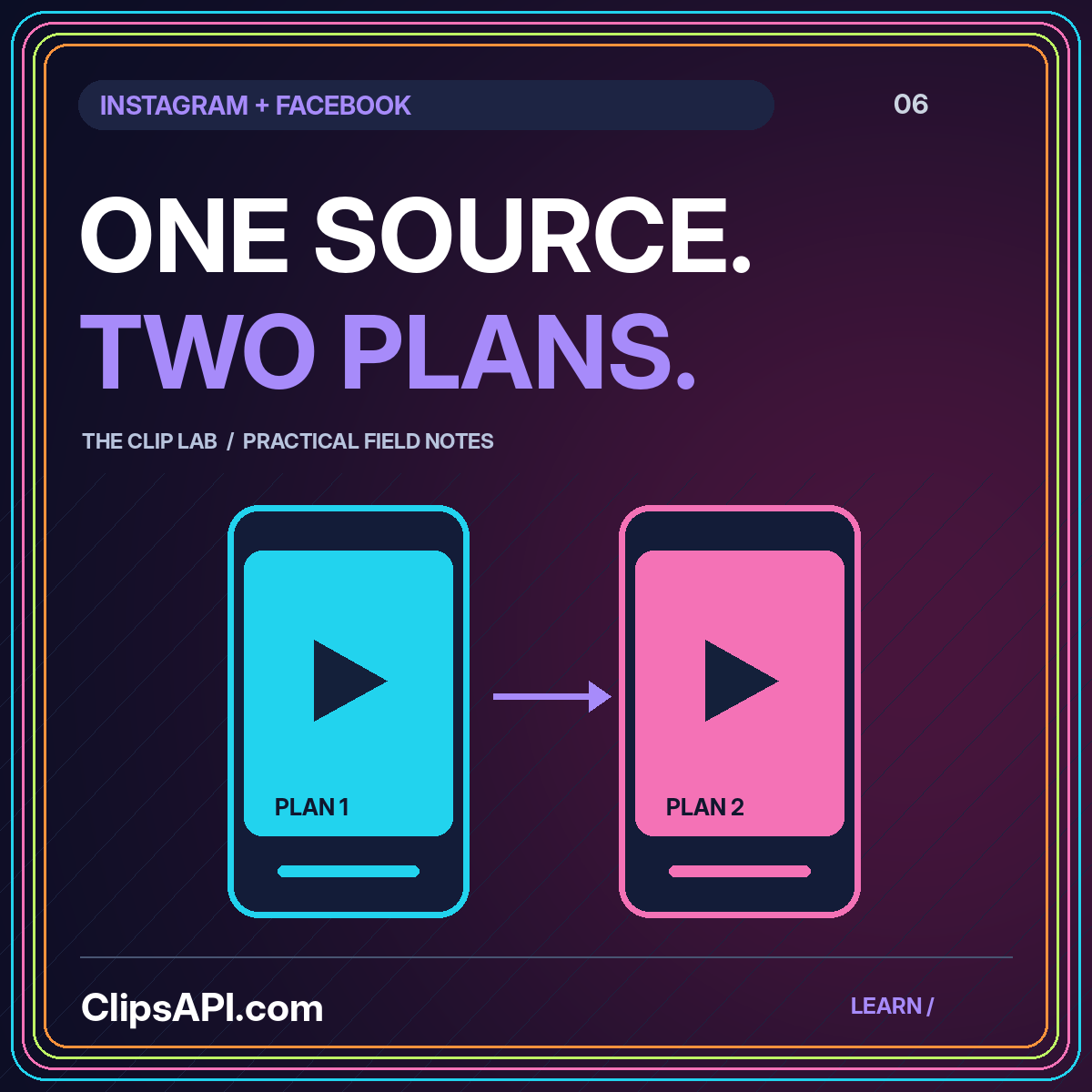
An Instagram and Facebook clip workflow should share editorial effort without pretending that the two publishing destinations are interchangeable. A team may use the same authorized source and creative brief, yet still need separate captions, approvals, destination records, and checks. Thinking in terms of two deliberate handoffs is clearer than treating a single “post everywhere” action as the entire workflow.
This guide proposes a publishing plan for creators and developers. It does not provide a connected Instagram or Facebook account, an upload tool, or a promise of API access. Use the Instagram Clips API guide and Facebook Clips API guide for their separate topic paths. The focus here is the shared production record that keeps cross-platform delivery understandable.
Start with one source and two destinations
Identify the approved source version before creating destination-specific clips. Record the purpose of the post, the person responsible for the media, and the person who can approve publication. Then create a destination record for each intended account or Page. Avoid using a display name alone: a team may manage several similarly named properties, and an accidental selection can be difficult to notice in a hurried handoff.
Keep the shared creative brief independent of each destination's publishing details. The brief might call for a self-contained product explanation, while the destination records hold the approved title, description, audience decisions, and publication status. This lets an editor reuse the underlying work without assuming that approval for one destination automatically applies to another. Treat cross-platform reuse as an explicit decision rather than a default side effect.
Distinguish upload, processing, and publication
Meta's official Facebook Reels publishing collection presents separate creation, upload, status, and publication stages for a Page Reel. That is a useful reminder that transferring a file and making a post public are different events. Do not use the completion of a local upload progress bar as the only evidence that the intended publication exists.
In your proposed workflow, keep a readable status for each destination: media prepared, transfer started, processing pending, ready for final action, published, or attention required. Use only states that map to the actual implementation you choose. When a provider changes its workflow, update the destination adapter instead of changing what the shared clip means. A failure on Facebook should not erase the fact that an Instagram version was already reviewed, or vice versa.
Make framing a destination-specific review
Begin with the content that must remain visible: the speaker, the demonstration, a label, or a visual comparison. A portrait crop may be suitable for one version, while another layout may need a wider view or a redesigned arrangement. Treat aspect ratios shown in planning documents as design choices until they are checked against the current destination requirements. Do not turn an old social-media cheat sheet into a permanent technical specification.
Preview the complete clip in the proposed layout rather than approving a still frame. A hand can move outside a crop, a title can enter from the side, and an explanatory object can appear late in the sequence. Keep essential words and visuals away from areas likely to compete with surrounding interface elements, then inspect the actual destination preview where available. The approval should refer to the rendered version, not merely the crop settings.
Write descriptions for the actual audience
A shared source does not require identical accompanying text. Decide what each audience needs to understand before viewing. A short description may introduce a demonstration, explain the source of an excerpt, or direct viewers to a related resource. Avoid promising information that the clip does not actually provide. Review the description together with the first frame so the promise and the visible opening support each other.
For a proposed editorial checklist, verify names, numbers, product references, attribution, and any qualification removed for brevity. Do not assume that a shortened caption preserves the same meaning as the original. If a clip discusses a limitation, the description should not turn it into an unconditional benefit. Keep the approved text in the destination record so a last-minute publishing change does not silently replace a carefully reviewed version.
Treat account access as a separate prerequisite
Before implementation, verify the current account eligibility, authorization flow, permissions, and review requirements in the relevant official documentation. These details belong to the actual application and destination; they are not supplied by this website. Do not present an account connection as complete merely because a person can view the public profile. Viewing content and receiving authorization to publish are different steps in a real integration.
Keep access credentials out of public HTML, example screenshots, and shared editorial documents. In a proposed application, the publishing component should obtain only the access necessary for its job. An editor preparing a draft may not need the same powers as a publisher distributing it. Design the handoff so a creator can see which destination is selected before a consequential action occurs.
Plan retries without making duplicate posts
A network interruption can leave a publisher unsure whether a request succeeded. Your operational design should preserve the clip version, destination, request reference, and any returned media or publication identifier. Before repeating a publication action, inspect the stored state and the provider's supported status mechanisms. Do not automatically start from the beginning whenever a browser or worker restarts.
Make the recovery screen or handoff note specific. “File transfer needs attention” is different from “publication outcome unknown.” The second condition deserves investigation before retrying. Keep the two destinations independent: a successful publication on one should not be repeated just because the other encountered a problem. For a manual workflow, a simple destination checklist with recorded links can provide the same essential discipline.
Review accessibility and context together
Watch the clip muted to check whether the visual explanation and captions remain understandable. Then listen without relying on the image to notice an audio transition or an unexplained reference. Review the names and technical terms that automated captions are most likely to need checked. This is a proposed human review method, not a claim that any provider has verified the output for you.
Preserve the original source and the final text after publication. When an error is discovered, the team should be able to determine whether the issue came from the edit, the caption file, the destination description, or an incorrect upload selection. Assign someone to check the published result rather than assuming that a successful response means the presentation looks exactly as expected.
A hypothetical two-destination release
A creator prepares a product demonstration from an authorized master. The editor creates a portrait version and writes two descriptions for different audiences. Each destination receives its own approval record. One upload completes while the other needs a corrected file. The completed destination stays recorded as successful; the second returns to media preparation. After publication, the reviewer inspects both results and records their separate public locations.
A practical acceptance exercise
Before the first two-destination release, rehearse the handoff with a deliberately renamed export and an outdated description. The reviewer should be able to identify both mismatches from the source and destination records rather than from memory. Also rehearse a release in which one destination is canceled after the other succeeds. A clear workflow preserves the successful record and explains the canceled action without suggesting that the entire project either failed or published twice.
Conclusion: share the edit, preserve the differences
A clear Instagram and Facebook workflow reuses source material and creative reasoning while keeping access, framing, descriptions, and publication state separate. Build the shared record first, then implement each destination according to its current documentation. For the underlying media contract, continue with the Clips API foundations guide and keep every public result connected to the version that was actually approved.