Clips API Foundations: Design a Reliable Video Workflow
Build a clear clipping contract with source versions, precise timing, recoverable jobs, and reviewed outputs.
Start with the contract behind every clip.
A Clips API can describe the contract between a requesting application and a media workflow. Start by deciding whether the project needs a selected interval, a rendered file, a searchable library entry, or a publishing handoff. These are related outputs, but they should not become one ambiguous operation.
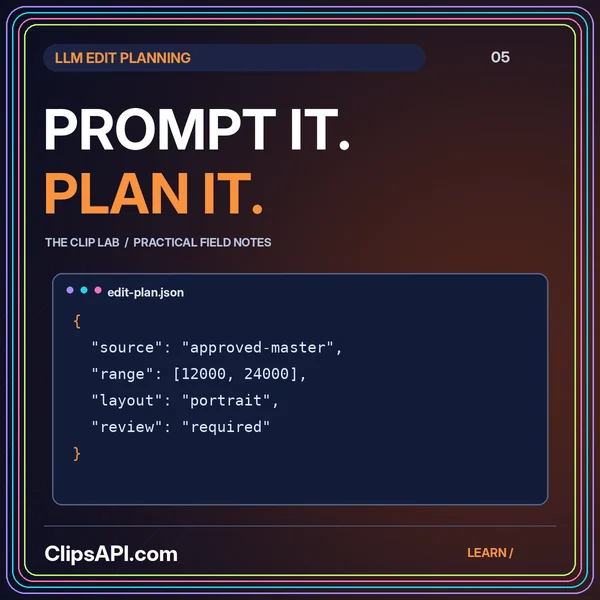
Keep the source master, the instruction to edit it, and a particular execution attempt as separate records. That proposed structure helps an operator distinguish a new creative request from a retry. Give approved outputs stable identifiers so temporary delivery locations do not become the only way to recognize them.
A missing source, an invalid interval, and a transfer failure call for different next steps. Define readable states and specific errors. Preserve enough history to explain which stage needs attention, and do not silently start a second publication just because a requester repeats an earlier action.
Choose one authorized source location, one output profile, and a deliberate review handoff for a first implementation. Test repeated requests, canceled jobs, and intervals outside the media duration. Expand the supported cases after the team can explain both the successful path and the recovery path.
No. This is an independent educational resource. The pages explain contracts and workflows; they do not provide a hosted clipping endpoint, account connection, or API-key service.
Build a clear clipping contract with source versions, precise timing, recoverable jobs, and reviewed outputs.
Give natural-language edits a clear structure, validation rules, evidence, and deliberate approval boundaries.